The adoption of Artificial Intelligence (AI) within industry requires robust infrastructure, clear governance, widespread literacy, and a phased approach to deliver genuine value. For Eletech, the R&D hub of the Elemaster Group, technology is not a superficial addition but a seamless extension of industrial processes. This vision becomes especially relevant in highly regulated and often mission-critical sectors, including medical, railway and industrial environments, where reliability, control and traceability are essential conditions for innovation.
AI only generates value when built upon solid foundations. It acts as an amplifier rather than a „magic fix“: it magnifies the environment it is introduced to. If processes are disordered, it amplifies chaos; if data is fragile, it amplifies error; and if the workforce is sidelined, it amplifies resistance. Consequently, AI adoption must begin with a deliberate redesign of workflows rather than mere technological enthusiasm.
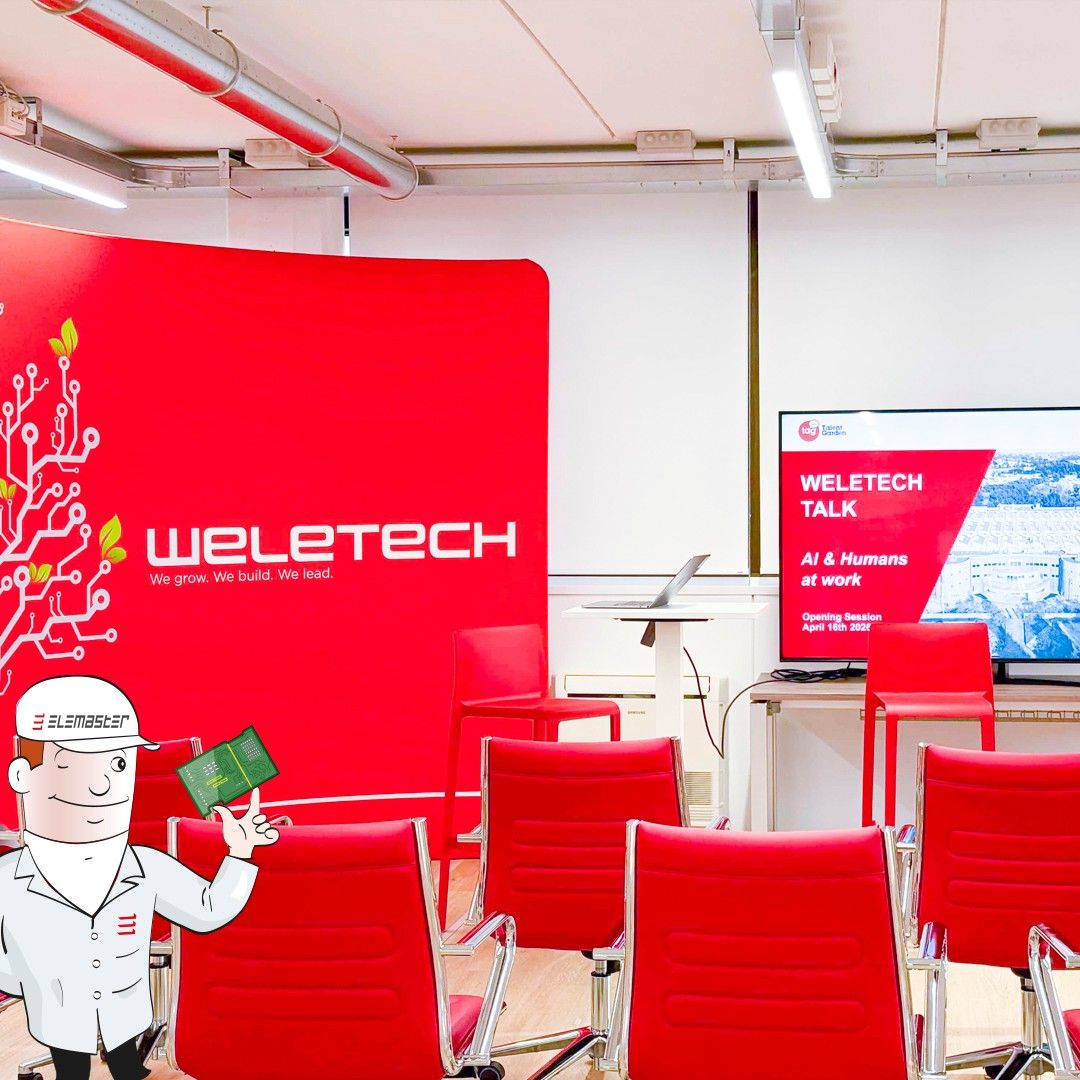
The recent Weletech Talk, an assembly of managers, innovators, and industry specialists, marked the start of a broader strategic journey. The goal was to define how to integrate AI pragmatically and scalably to ensure real industrial impact.
The event served as the launchpad for Eletest, a proprietary platform evolved to integrate advanced analytics, data correlation, and predictive maintenance support. Eletest stands as a primary tangible example of measurable and reliable AI application within electronic testing and validation. This direct experience informs the Elemaster Group’s wider strategic vision for corporate AI adoption.
Prioritising problems over algorithms
To unlock the potential of AI, organisations must first undergo structural redesign. AI is most effective when addressing operational friction: points where workflows stall, repetitive tasks consume resources, or knowledge becomes siloed. By mitigating this „cognitive waste,“ AI allows personnel to focus on high-value activities.
Effective implementation avoids inserting AI into chaotic processes; instead, it requires clarifying the underlying work structure. Automation only becomes viable once roles, flows, and responsibilities are clearly defined. Without rigorous design, AI risks multiplying complexity rather than solving it.
Data quality: the foundation of intelligence
In the industrial sector, data quality is the primary determinant of AI success, as fragmented or ungoverned data undermines reliability and prevents scaling. AI requires a continuous, standardised, and secure information architecture to function effectively. For Eletech, this involves a commitment to data hygiene through the cleaning and integration of data streams. Furthermore, the adoption of clear governance models and, where necessary, on-prem or edge architectures ensures maximum control, privacy, and security. Ultimately, intelligence is not derived from the algorithm itself, but from the structural integrity and solidity of the information backbone.
Human in the loop: trust as a prerequisite
AI adoption represents an evolutionary shift in organisational structure where automation must be balanced with human supervision, as quality, responsibility, and interpretation remain irreplaceable.
Building trust is a collaborative journey that begins with visible leadership and transparent policies, supported by continuous training. The presence of internal champions facilitates adoption, while co-creation with end-users ensures that AI is perceived as a support tool integrated into daily work rather than an external threat or imposition.
Transformation via „Quick Wins“
Eletech’s experience shows that the most effective transformations begin with targeted interventions that yield immediate results. These „Quick Wins“ build institutional trust and reduce cultural resistance.
Familiar tools like Microsoft 365 Copilot and Teams demonstrate how AI can be introduced without disrupting established habits. Similarly, internal virtual assistants like „Albert“ become a natural part of the corporate ecosystem, supporting onboarding, cybersecurity, and assistance flows. These incremental successes bridge the gap between experimentation and full-scale industrialisation.
Eletest: an AI-Ready industrial platform
The culmination of this strategy is the evolution of Eletest, Eletech’s proprietary testing platform. With version 2.0, Eletech demonstrates how AI can be embedded into a standardised industrial base.
The platform is specifically designed to aggregate information from multiple environments and testing platforms, utilising an on-prem architecture to guarantee security and control.
On this foundation, AI acts as a strategic ally in identifying correlations, recognizing patterns, performing root cause analysis, enabling predictive maintenance, and improving OEE (Overall Equipment Effectiveness) and reliability.
The platform incorporates security by design principles, with integrated prompt governance, permissions, privacy, and auditing. It is a concrete example of how AI can be applied industrially, transforming distributed data into actionable insights. This approach is further strengthened by Eletech’s expertise in embedded hardware and software development, which represents a key enabler for AI integration in real products and systems. In this sense, AI is not treated as an isolated digital layer, but as a capability that can be embedded into the architecture of devices, machines and electronic systems developed for demanding application contexts.
AI as industrial method and infrastructure
AI adoption today parallels the introduction of electricity in 20th-century factories. The debate has shifted from its utility to its effective integration. Just as electricity became an „invisible“ standard, AI is destined to become a fundamental industrial method.
The challenge for companies is twofold: leveraging existing data to drive innovation while designing products capable of intelligent self-management throughout their lifecycle.
“We aim to be partners in our customers‘ evolutionary trajectory: design must now inherently account for the opportunities opened by AI. Together, we must conceive user-friendly products capable of advanced data processing and transmission”,
explains Valentina Cogliati, President of Elemaster Group.
“Furthermore, we must use the data already at our disposal to drive innovation, enhance performance, and support lifecycle management”.
The strategic reflection on AI extends far beyond a single event like the recent Weletech Talk. For Eletech, this marks the inception of a structured, long-term journey, a permanent platform where technology, industrial expertise, and operational execution converge around a pragmatic agenda.
AI is not a distant horizon but a pragmatic, permanent platform where technology and execution meet. Eletech’s vision is to ensure AI remains concrete, scalable, and indispensable to modern industry.