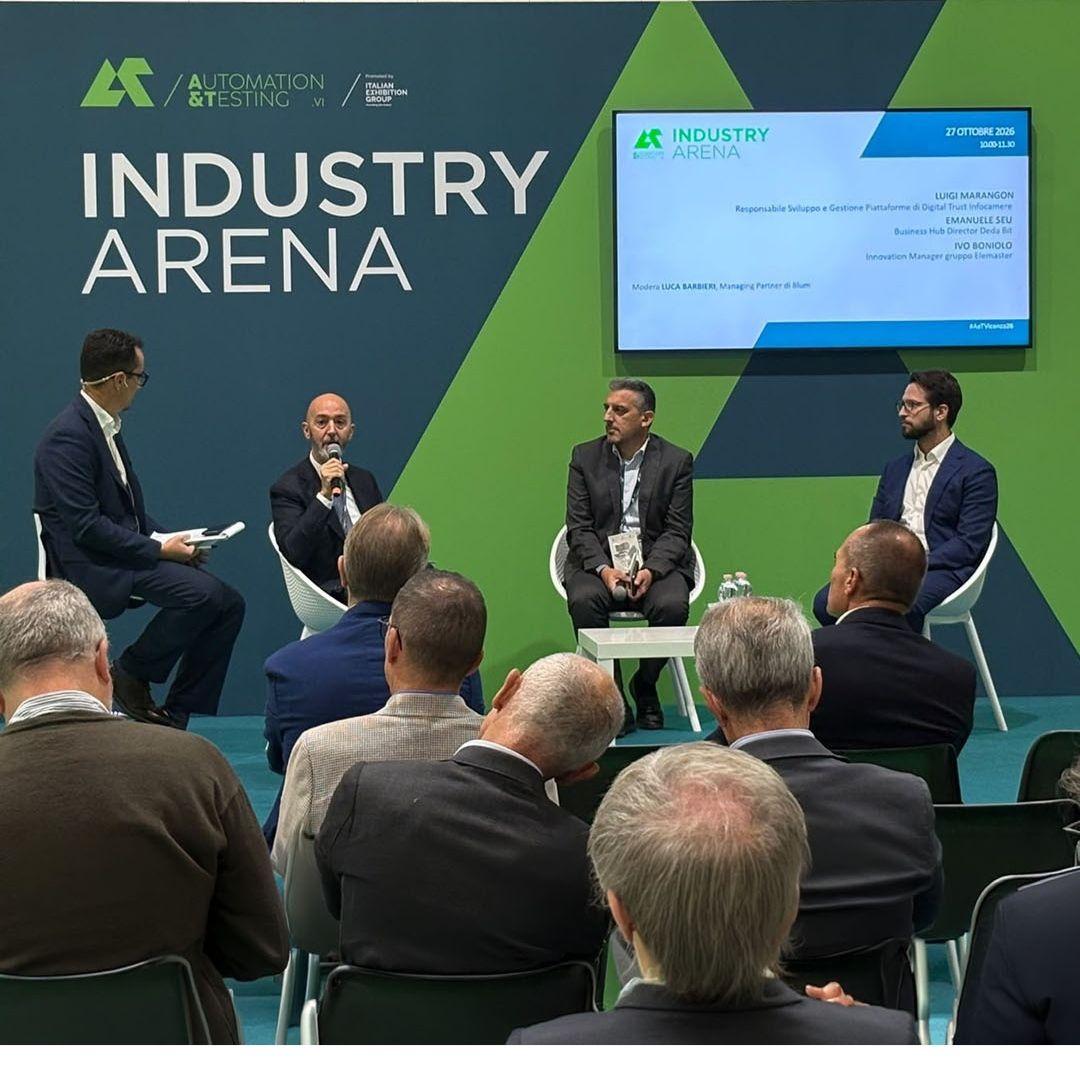
Ivo Boniolo, Innovation Manager at Elemaster Group, took part as a speaker in the opening conference “Tecnologie per l’AI: opportunità e sfide per le PMI – Infrastrutture, competenze e strumenti che rendono possibile la rivoluzione oggi”, organised within A&T in Vicenza.
The panel featured Luigi Marangon, Head of Digital Trust Platform Development and Management at InfoCamere and Emanuele Seu, Business Hub Director at Deda Bit. The discussion was moderated by Luca Barbieri, Managing Partner at Blum.
The discussion moved beyond the most visible side of Artificial Intelligence – from large language models (LLMs) to chatbots – to explore what AI really means for companies and, in particular, for the Italian manufacturing ecosystem and SMEs.
From Elemaster Group’s perspective as an industrial manufacturer, the growing demand for AI-enabled devices and infrastructure for use within companies presents significant opportunities. However, adopting new technologies is not enough in itself. AI must serve the company, not the other way round. Its implementation needs to be guided by clear objectives, appropriate governance and a thorough understanding of the business processes it is intended to support. The challenge is to harness AI’s potential without losing control over the knowledge, decisions and expertise that define a company’s identity and competitive advantage.
Another key topic was the expansion of data centres and AI infrastructure, whose impact extends well beyond the digital sector. The real challenge lies in the integration and interconnection of industrial supply chains. As demand for computing capacity and electronic components grows, procurement constraints and the availability of raw materials can no longer be considered isolated issues: they become challenges for entire, interconnected supply chains, requiring coordination and a broader industrial perspective.
Boniolo also presented ELEVO Innovation Hub, Elemaster Group’s proprietary model for managing innovation. Rather than relying solely on a funding-driven approach, such as the model often associated with the US startup ecosystem, ELEVO focuses on accompanying ideas throughout their development: helping them mature, connecting technological potential with industrial expertise, and turning promising concepts into solutions that can be manufactured, scaled and brought to market. Innovation is not simply about generating ideas or investing in them; it is about creating the conditions that enable them to become industrial reality.
The discussion also addressed how companies can organise AI adoption through a structured approach, such as an AI Foundry, bringing together data, technologies, skills and applications within a secure, controlled and scalable framework. For SMEs in particular, the priority is to move beyond isolated experiments and ensure that AI delivers measurable value while remaining aligned with business needs.
This perspective also raises a fundamental question about the relationship between data and industrial knowledge. Data may represent a relatively recent layer in the history of industry, but every company has built up a deeper body of experience, expertise and know-how over time. This is its industrial brain: the knowledge embedded in its people, processes, decisions and accumulated experience.
“The so-called Moravec’s paradox offers a useful lens through which to consider this challenge: capabilities that appear straightforward to humans can be remarkably difficult for machines to replicate, while tasks requiring complex information processing can be easier to automate. In this example, data represents the most recent part of the evolution, while what must be protected is the ‘brain’ that makes each company unique, and which is not replicable by AI” commented Boniolo, closing the conference and underlining that for Elemaster Group the objective is therefore not simply to adopt AI, but to integrate it intelligently into the industrial environment.