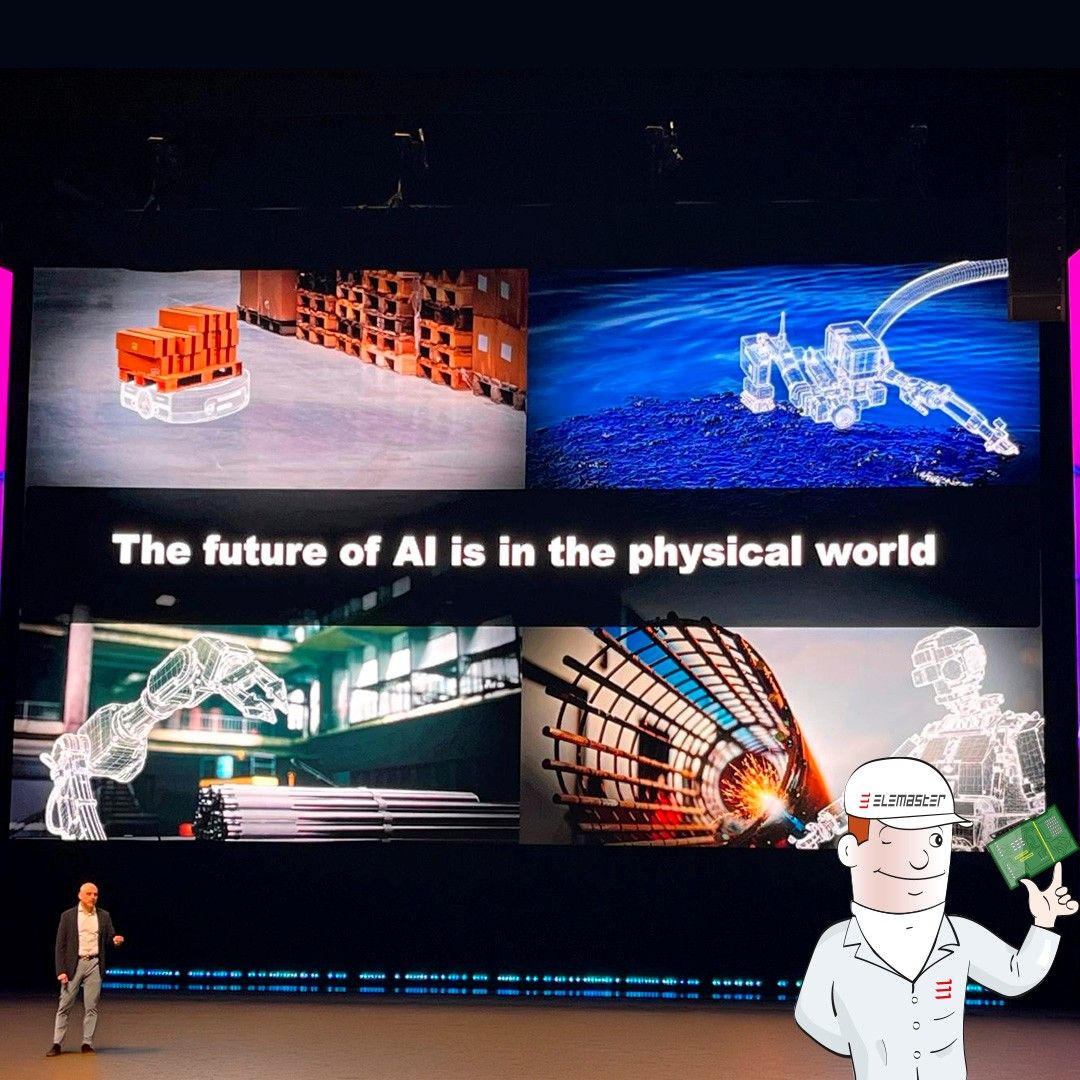
Why scalability starts from electronics. Ideas from ITF World 2026
For years, artificial intelligence has mainly been discussed through the lens of models, data and software. Yet the next stage of its evolution is becoming increasingly tied to a more tangible dimension: the physical infrastructure needed to make AI scalable.
This was one of the strongest messages that emerged from ITF World 2026, the global technology forum organised by imec in Antwerp, where Elemaster Group was represented by President & CEO Valentina Cogliati and Innovation Manager Ivo Boniolo. The event gathered leading voices from the semiconductor, computing and deep tech ecosystems to explore how AI is transforming the technology stack, from chips and data centres to robotics, mobility, healthcare and industrial systems.
The expression “physical AI” helps describe part of this evolution, but it does not capture the whole picture. The main issue is not only that artificial intelligence is moving from cloud environments into robots, vehicles, machines and connected objects. The deeper transformation is that AI is becoming an infrastructure challenge.
When AI enters physical environments, performance can no longer be measured only through model accuracy or computational capacity. It depends on where data is processed, how quickly decisions are made, how much energy is required, how heat is managed, how memory and processing are integrated, and whether the final system can be validated, certified and manufactured at scale.
In this perspective, the future of AI is not only physical. It is also architectural, electronic and industrial.
Scaling AI requires infrastructure
At ITF World, the discussion moved towards a strongly industrial interpretation of AI scalability. Bringing AI into products and systems means facing very concrete constraints: energy consumption, latency, heat dissipation, bandwidth, memory, packaging, local control and manufacturability.
Several sessions addressed this same direction. Christophe Fouquet, President and CEO of ASML, explained how AI is accelerating transformation across the semiconductor industry, opening new opportunities for lithography, 3D integration, metrology and advanced packaging. Kevin Zhang of TSMC focused on the platform technologies required to support future AI applications, from advanced integration and 3D stacking to silicon photonics and integrated voltage regulation.
Patrick Vandenameele, CEO of imec, identified scalability as the central challenge for the next AI era. Other contributions, including those from Arthur Mensch, co-founder and CEO of Mistral AI, expanded the conversation to full-stack AI capabilities, from models and enterprise deployment to compute infrastructure.
The underlying message was consistent: AI progress can no longer be evaluated only through algorithms or peak computing performance. It depends on the interaction between models, semiconductor scaling, interconnects, system architectures and manufacturing capacity.
Why co-development is becoming essential
This is where the conversation shifts from technology to industrial strategy. In the past, innovation could often evolve through relatively separate layers. A chipmaker could work on processor improvement, a software company could optimise an algorithm, and a manufacturer could concentrate on production efficiency. In the AI era, this separation is becoming less effective.
When AI is embedded into a product, these layers become interdependent, and the speed of technological change makes this interdependence more difficult to manage. The rapid adoption of AI agents, the growing depth of training processes and the increasing capabilities of models are placing greater pressure on the underlying infrastructure.
The way a system processes data influences the type of chip it requires. Chip architecture affects energy consumption and heat dissipation. Energy and thermal limits influence product design. Product design then affects manufacturing, reliability, testing and certification. In this context, co-design is no longer optional: it is the only way to keep technology development aligned with the pace at which AI is evolving.
This means that performance cannot be added at the end of the process. It must be designed from the beginning, across the full chain.
For this reason, co-development is becoming a structural requirement. Semiconductor companies, electronics manufacturers, software developers, research centres, equipment suppliers and application specialists need to collaborate earlier and more closely. Each actor contributes a specific competence, but value emerges only when those competences are coordinated.
The same logic applies to emerging technological directions such as neuromorphic chips and quantum computing, both discussed during the event. These are different paths, with different levels of maturity, but they respond to the same broader challenge: overcoming the physical and computational limits of current architectures.
From co-development to co-innovation
Co-development concerns the technological stack. Co-innovation takes the discussion further, asking how those technologies can become real products.
This is a decisive step for advanced electronics. AI becomes useful when it is reliable, repeatable, producible and scalable. In sectors such as healthcare, mobility, robotics, aerospace and industrial automation, this means going beyond the prototype and addressing quality, supply chain, validation, regulatory requirements and long-term performance.
The examples presented at ITF World made this transition clear. AI systems are moving towards distributed architectures, where data is processed closer to its source and decisions are made with lower latency. This is especially relevant for machines, vehicles and industrial systems, where local control and deterministic behaviour are more important than headline performance.
In this context, electronics becomes the meeting point between software intelligence, physical constraints and industrial requirements.
“AI will not scale in the physical world by adding intelligence at the end of the product,” says Ivo Boniolo, Innovation Manager at Elemaster “It has to be designed into the architecture from the beginning. Latency, energy, heat, memory, sensing, control, testing and manufacturability are no longer downstream constraints: they are part of the intelligence of the system. This is why electronics and industrial co-development will be decisive in the next phase of AI.”
The expression “physical AI” has been useful to describe the movement of artificial intelligence from cloud environments into machines, robots and real-world systems. Yet the term only describes the most visible part of a deeper transition. The future of AI may continue to be discussed through models and software, but it will be built through electronics, architectures and industrial collaboration.
Its next frontier is not only physical. It is distributed, shaped by real-world requirements and dependent on the ability of the technology ecosystem to innovate together.