Electronic products today operate in environments saturated with electromagnetic activity. Industrial equipment, medical devices, railway systems and household electronics coexist with switching circuits, radiofrequency transmissions, power electronics and increasingly complex digital infrastructures.
In such contexts, the ability of a product to function correctly without being affected by external disturbances is no longer a secondary requirement. It is a fundamental condition for reliability.
Electromagnetic compatibility is often associated with regulatory compliance to emission tests. Yet an equally important dimension concerns the opposite perspective: ensuring that electronic systems remain stable and operational when exposed to disturbances generated by the surrounding environment. This is precisely where immunity testing becomes essential.
Within the Laboratory of Eletech, the lead company of the International Design Centres (IDCs), R&D division of Elemaster Group, immunity testing is not treated merely as a formal verification step. Instead, it becomes a structured process for evaluating how robust an electronic system truly is when confronted with real-world electromagnetic phenomena.
Testing how systems behave under electromagnetic stress
Immunity testing evaluates the ability of a device to maintain its intended performance when exposed to specific electromagnetic disturbances. Rather than focusing on what a product emits, these tests analyse how systems react when disturbances are intentionally introduced through electrical interfaces.
In laboratory conditions, disturbances are injected into power lines or communication ports, reproducing phenomena commonly encountered in real operating environments. This allows engineers to observe how systems behave under stress conditions that closely resemble those experienced during everyday operation.
From this perspective, the laboratory acts as a controlled simulator of real-world conditions. Instead of waiting for unpredictable field failures, immunity testing anticipates those situations and makes them observable in a repeatable and measurable environment.
Reproducing electromagnetic disturbances in a controlled environment
Electronic systems may be affected by different types of electromagnetic disturbances, each originating from specific physical phenomena.
Within the Eletech Laboratory, engineers analyse three categories of disturbances that commonly occur in operational environments:
- EFT / Burst (Electrical Fast Transients), high-frequency disturbances with relatively low energy typically generated by switching events such as relays, contactors or inductive loads.
- Surge events, which simulate high-energy overvoltages induced by lightning strikes or disturbances in power distribution infrastructures.
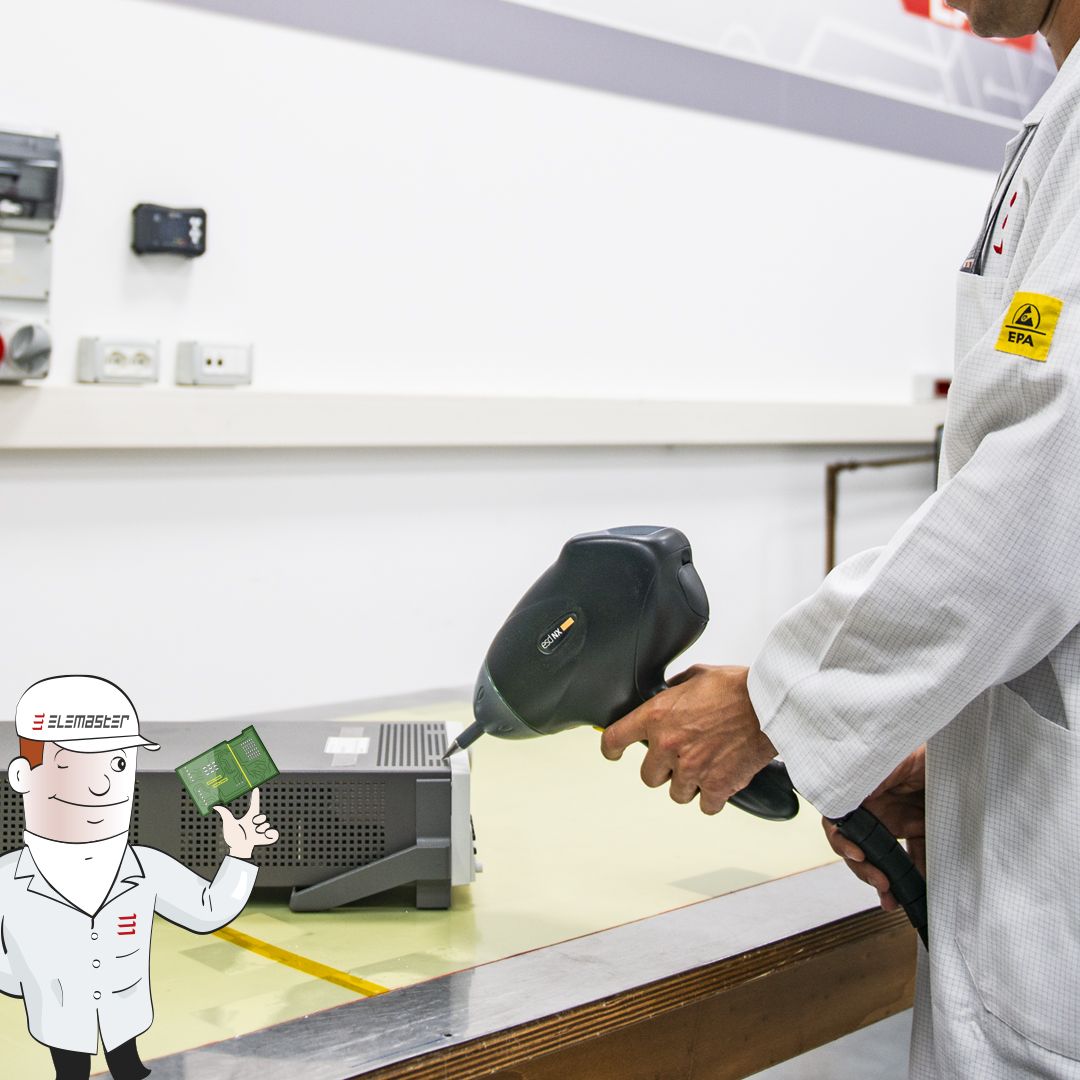
- Electrostatic discharge (ESD), sudden electrical discharges that occur when a charged person or object transfers electrostatic energy to an electronic device.
By reproducing these disturbances in a controlled environment, engineers gain insight into how systems respond to electromagnetic stress conditions that are often difficult to analyse directly in the field.
Evaluating system response through performance criteria
Immunity testing does not simply verify whether disturbances occur. It evaluates how the product behaves while the disturbance is applied and immediately afterwards.
International standards define several performance criteria describing acceptable system responses:
- Criterion A, where the product must continue operating normally during the disturbance without any degradation of its intended performance.
- Criterion B, which allows temporary degradation while the disturbance is present, provided the system automatically recovers once the disturbance ends.
- Criterion C, where temporary interruption is permitted and manual intervention may be required to restore normal functionality.
These criteria provide engineers with a structured framework for assessing system robustness and determining whether the design meets the performance expectations defined by product standards.
Beyond compliance: testing for real robustness
Although regulatory standards define minimum immunity levels, many manufacturers choose to go beyond these thresholds. Meeting the minimum requirement may allow certification, but it does not necessarily guarantee robust behaviour in real operating environments.
For this reason, immunity testing is often extended beyond normative limits. Disturbance levels may be increased, or operating conditions varied to simulate more demanding scenarios such as switching loads, power fluctuations or unbalanced operating conditions.
In this context, testing evolves from a compliance activity into a tool for improving product robustness. Observing how systems behave under harsher conditions enables designers to refine architectures and protective strategies before products reach the market.
Pre-compliance testing as a design tool
One of the most effective ways to leverage immunity testing is to perform it early in the development cycle.
Pre-compliance activities allow engineers to test prototypes before final certification, when design changes are still feasible. At this stage, testing can reveal weaknesses that might otherwise remain hidden until later phases of development.
Issues related to PCB layout, filtering strategies, internal cabling or enclosure shielding can be identified and corrected while the system architecture remains flexible.
Detecting problems during the prototyping phase significantly reduces the risk of certification failures, costly redesigns and development delays. In this sense, pre-compliance testing becomes an engineering tool that accelerates development while improving reliability.
Engineering expertise behind EMC testing
While testing equipment and procedures are defined by international standards, the effectiveness of immunity testing ultimately depends on engineering expertise.
Before performing any test, the Eletech Laboratory collaborates closely with manufacturers to analyse product architecture. Engineers examine aspects such as system interfaces, cable routing and the real operating conditions in which the product will be used.
This preliminary analysis allows the definition of a test plan that accurately reflects the behaviour of the system in its intended operating environment. The plan is verified both through documentation analysis and direct inspection of the prototype.
In specific sectors, such as railway applications, particular testing configurations may also be required. Ports connected to the train’s battery system, for example, may require disturbances to be directly coupled to the cable, while other interfaces can be evaluated through indirect coupling techniques.
An integrated ecosystem for EMC testing
The presence of the Eletech Laboratory within the broader Elemaster ecosystem creates an environment in which testing, design and industrialisation operate in close coordination.
Access to specialised laboratory capabilities allows engineers to analyse system behaviour during development rather than after design decisions have been finalised. This integration reduces iteration cycles and enables faster responses when design adjustments are required.
For customers, immunity testing therefore becomes part of a broader engineering process rather than a standalone certification step.
Robustness as a strategic objective
As electronic systems become increasingly complex and interconnected, their exposure to electromagnetic disturbances inevitably grows.
Ensuring that products remain stable under such conditions is no longer simply a regulatory obligation. It is a key component of product quality.
Through controlled simulation of real-world disturbances, immunity testing allows engineers to observe and understand how systems behave under electromagnetic stress. Combined with early testing strategies and collaborative engineering approaches, these activities contribute directly to the development of more reliable electronic products.
In this perspective, immunity testing becomes not only a requirement for compliance, but a strategic instrument for designing electronic systems capable of performing consistently in the environments where they will ultimately operate.