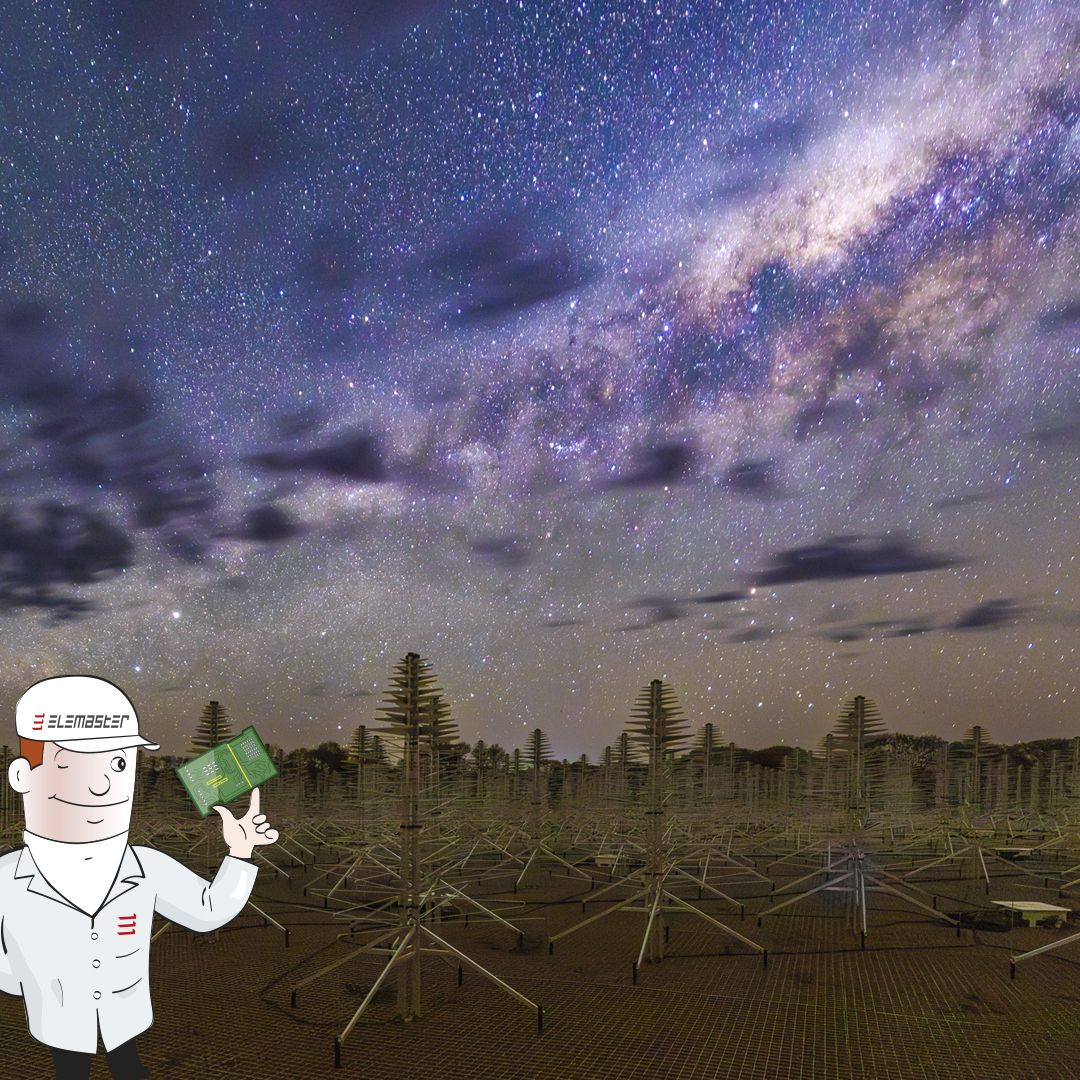
Some scientific instruments help us observe the universe more clearly. Others allow us to ask questions that were previously impossible to formulate. The SKA telescopes belong to the second category.
The SKA Observatory is not simply building radio telescopes. It is building instruments designed to detect signals so faint and distant that they push the limits of observation.
At this scale, science, data and electronics become inseparable.
Looking back to the first light of the universe
One of SKAO’s most ambitious objectives is to explore the so-called Cosmic Dawn, focusing on some of the most fundamental moments in cosmic history:
- the formation of the first stars
- the emergence of early galaxies
- the organisation of matter into large-scale cosmic structures
These early structures emitted light like all galaxies, but because they are extremely distant, their radiation has been stretched towards longer wavelengths by the expansion of the Universe. Much of this information is therefore encoded in low-frequency radio waves that have travelled across the cosmos for billions of years. Capturing them requires extreme sensitivity, wide bandwidth and precise calibration across vast antenna arrays.
By observing these signals, the SKA telescopes will allow scientists to reconstruct how matter coalesced into the first luminous objects, shedding light on the origins of galaxies, cosmic structures and the conditions that made life possible.
Pulsars, time and the fabric of space-time
Pulsars are among the most precise natural clocks in the universe. These rapidly rotating neutron stars emit radio pulses with astonishing regularity, making them invaluable tools for fundamental physics.
By monitoring networks of pulsars distributed across the sky, the SKA telescopes will enable experiments that probe:
- the behaviour of gravity on a cosmic scale
- variations in space-time (gravitational waves) caused by massive astrophysical events such as merging supermassive black holes
In this context, timing accuracy is not just an engineering requirement. It becomes a gateway to observing phenomena that reshape our understanding of space-time itself.
From radio signals to the search for technosignatures
Beyond astrophysics and cosmology, the SKAO opens the door to one of the most profound scientific questions: are we alone in the universe?
The telescopes’ unprecedented sensitivity will allow researchers to search for technosignatures, radio signals that could indicate the presence of advanced technological activity beyond Earth. Unlike speculative approaches, this search is grounded in rigorous signal analysis, pattern recognition and statistical validation.
Detecting potential technosignatures requires:
- filtering vast volumes of radio data
- distinguishing natural cosmic emissions from artificial patterns
- applying rigorous statistical validation techniques
Here again, the challenge is not only scientific. It is computational and technological, demanding infrastructures capable of handling complexity at scale.
Why advanced electronics make this science possible
None of these scientific goals can be achieved without electronics capable of operating at the edge of feasibility.
The SKA telescopes will generate data volumes that far exceed those of most existing scientific instruments. Signals must be digitised at high speed, synchronised across thousands of antennas and processed in real time before being transferred to global data centres.
Advanced electronics enable this entire chain, including:
- high-speed digitalisation
- precision timing distribution
- real-time signal processing architectures
- reliable system integration
In this sense, electronics does not sit behind the science. It defines what science can be done.
“How big is it?”: when scale becomes real
The scale of the SKA telescopes is difficult to grasp, even for those working on the project. During one conversation, Marco Arrigoni, Eletech System Engineer and technical leader for the SKA project, asked a simple question: “How big is it?”
The answer was disarmingly concrete. The SKA-Low telescope in Australia extends across 74 kilometres.
At that moment, the project shifted from abstract diagrams and specifications to a physical reality. A system spanning tens of kilometres, synchronised down to fractions of a nanosecond, operating as a single scientific instrument.
This sense of scale is essential to understanding the SKAO. It is not only large in size, but in ambition, complexity and impact.
Electronics as an enabler of human knowledge
At the heart of the SKAO lies a simple yet powerful idea: expanding human knowledge requires expanding our ability to observe, measure and interpret reality.
Electronics plays a central role in this process. By enabling precision, scalability and reliability, it allows scientists to explore domains that were previously inaccessible. It turns faint signals into meaningful data, and data into understanding.
For Elemaster, working with the SKAO means participating in this broader mission. It means applying industrial engineering capabilities not only to build systems, but to support the advancement of science and knowledge on a global scale.
A new window on the universe
The SKAO will not provide a single discovery or a definitive answer. Instead, it will open a new observational window, one that will remain active for decades and support generations of researchers.
Through its observations, the telescopes will help humanity better understand its place in the universe. It will challenge existing theories, inspire new ones and continuously redefine the boundaries of what we know.
In this sense, the SKAO is more than a scientific instrument. It is a long-term investment in curiosity, collaboration and discovery. And at its core, it reminds us that technology, when designed and applied with purpose, can become one of the most powerful tools for expanding human understanding.
With the SKAO, the universe does not simply become larger. It becomes more intelligible.
Photo Description: The Milky Way over the SKA-Low telescope on Wajarri Country in Western Australia.
Photo Credits: CSIRO/Ken Lawson