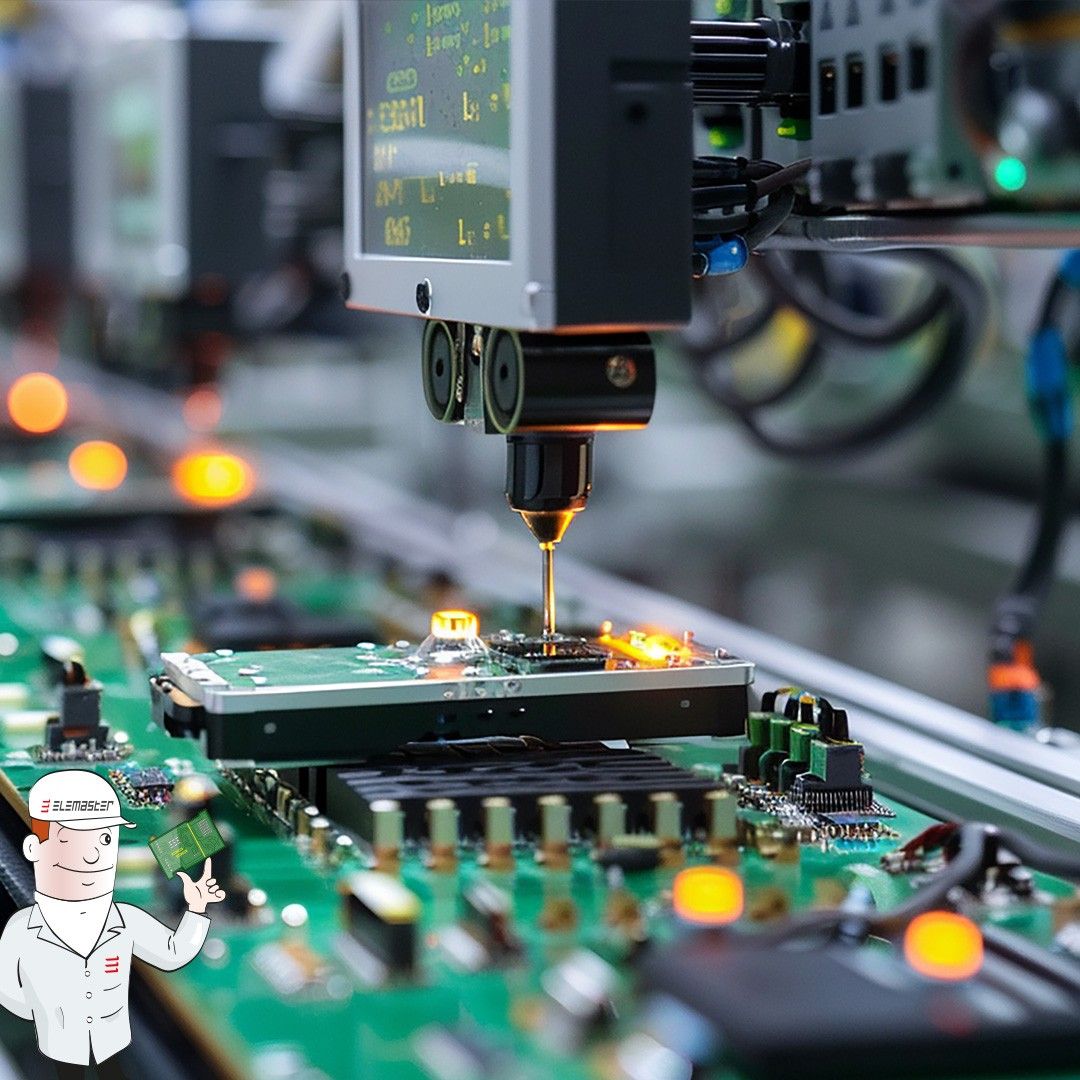
Europe’s electronics industry is facing a period of significant transformation. Component shortages, the growing demand generated by artificial intelligence and changes in the industrial landscape are placing increasing pressure on established supply chains and business models.
In this changing environment, Value Engineering is emerging as a way to address new industrial challenges by combining advanced artificial intelligence tools with human expertise and experience. At the same time, bringing startups and established manufacturers together before product design is finalised can encourage the exchange of ideas and help traditional companies explore new directions.
At electronica 2026, Elemaster, the Italian international engineering and manufacturing group, will present an approach built around these principles, demonstrating how industrial expertise and open innovation can contribute to the evolution of electronics manufacturing.
A new direction for Europe’s electronics industry
For decades, the European electronics market has been closely connected to the automotive industry and other established sectors. Today, however, new areas of demand are changing this balance. Energy efficiency, data centres and humanoid robotics are becoming increasingly relevant, creating opportunities that extend beyond the industries that have traditionally shaped the market.
According to Giovanni Cogliati, Vice President & Chief Commercial Officer at Elemaster Group Electronic Technologies, this transformation represents a long-term structural change rather than a temporary market fluctuation.
“The whole European market has to reposition itself, adding new business fields to the current industry driven mainly by automotive and traditional sectors. Energy efficiency, data centres, humanoid robotics: it is an epochal shift, perhaps towards a new industrial revolution that will last the next ten years, maybe more.”
For the Electronics Manufacturing Services (EMS) sector, responding to this evolution means more than expanding production volumes. Manufacturers must reconsider the services they provide and develop a value proposition capable of addressing new technological and industrial requirements.
Elemaster identifies this evolution through its VALUE ENGINEERING approach, which aims to extend the contribution of manufacturing expertise beyond traditional production activities.
Value Engineering as a response to supply chain challenges
The transition is taking place against a background of persistent pressure on electronic component availability. Memories, multilayer ceramic capacitors (MLCCs) and printed circuit boards (PCBs) are experiencing supply constraints, with the expansion of artificial intelligence applications contributing significantly to demand.
According to eeNews Europe, AI servers require ten to fifteen times more MLCCs than general-purpose servers. Lead times for high-capacitance components have exceeded 20 weeks, while passive component prices have increased by an average of 10 to 15%.
Similarly, TrendForce expects DRAM supply to remain constrained through 2027, as the production of high-bandwidth memory (HBM) absorbs wafer manufacturing capacity.
For Elemaster, addressing these conditions requires helping customers identify effective solutions to both component shortages and obsolescence risks. The Group’s Value Engineering team combines advanced AI-based engineering tools with 50 years of accumulated human intelligence and experience, bringing together technological analysis and practical industrial knowledge.
The process begins with a detailed examination of the product, including Design for Manufacturability (DFM) and Design for Testability (DFT). These established engineering activities are complemented by Design for Supply Chain, which evaluates the lifecycle status of the entire bill of materials (BOM).
This analysis makes it possible to identify critical elements before they become obstacles to production, including single-source components, obsolete or mature parts and components with extended lead times.
Once these risks have been identified, Elemaster’s Component Engineering Team examines the market for suitable pin-to-pin alternatives, which are then proposed to customers for validation.
When replacement components cannot be found, purchasing additional stock may provide an immediate solution. However, this approach is not always feasible and remains temporary, while also requiring companies to commit financial resources to inventory.
Value Engineering offers another possibility: identifying a product redesign that minimises changes to the existing architecture while improving cost competitiveness and ensuring greater long-term supply chain sustainability. Where possible, redesign activities may also introduce new product features, helping customers strengthen their position and gain market share.
An additional advantage comes from Elemaster’s in-house PCB manufacturing capabilities. A dedicated factory within the same industrial compound can produce complex multilayer printed circuit boards with rapid turnaround times, supporting redesign and manufacturing activities within a closely integrated industrial environment.
This capability, described as unique within the European EMS landscape, provides a competitive advantage under the current supply chain conditions.
Connecting startups and manufacturers through open innovation
While technological startups and component shortages may appear to represent separate challenges, they share an important underlying principle: difficult situations often require solutions developed beyond established ways of thinking.
There is no direct technical connection between a startup’s product and the shortage of a particular capacitor. What links these areas is the opportunity to approach problems differently, involving expertise and perspectives outside traditional relationships between manufacturers, suppliers and customers.
Startups frequently introduce unconventional technological ideas but may lack the industrial experience necessary to manufacture products at scale. Questions relating to production costs, future supply constraints and the consequences of early design decisions can become significant obstacles as a company grows.
Established manufacturers, by contrast, have extensive knowledge of production processes, access to structured supply chains and relationships with multinational customers. However, they may have fewer opportunities to identify emerging technologies and developments outside their existing industrial networks.
Bringing these complementary capabilities together is the objective of Elevo Innovation Hub, the initiative launched by Elemaster in October 2025 to help young companies transform their ideas into industrially viable products.
Elevo becomes involved during the product architecture phase, when decisions affecting manufacturing costs and industrial feasibility can still be reviewed. The initiative operates on a break-even basis, without acquiring equity stakes in the startups it supports.
The benefits of this collaboration extend in both directions. Startups gain access to industrial knowledge at an early stage of development, while Elemaster can strengthen its innovation scouting activities for customers and encourage the cross-fertilisation of ideas between established industries and emerging businesses.
Bringing the model to electronica 2026
Elemaster will present this approach in a tangible form for the first time at electronica 2026, taking place at Messe München from 10 to 13 November.
The Group’s exhibition space will be divided into two complementary areas. One will present Elemaster’s established services, including PCB manufacturing, electronic assembly, testing and design. The other will be dedicated to four startups, demonstrating how innovative technologies and industrial manufacturing expertise can coexist within the same ecosystem.
One of the participating startups is also expected to announce the closing of an investment round on the eve of the exhibition.
The four companies represent different technological fields, reflecting several of the industrial developments discussed throughout the article.
Coera, based in Berlin, develops “Intelligent Safety” software that enables robots to perceive the presence of people and adapt their behaviour accordingly. This capability is a prerequisite for allowing humans and robots to share working environments.
Novac, from Modena, develops lithium-free, solid-state supercapacitors. According to the company, its technology can withstand up to one million charge cycles.
Mawip, based in Milan, creates hybrid acoustic wind instruments with MIDI capabilities. Its products involve demanding miniaturisation requirements and represent an application that differs from those typically encountered at an electronics trade exhibition.
Levitology specialises in the development of customised levitation systems for product display, offering another example of how innovative technological concepts can be developed into specific applications.
Together, these four startups demonstrate the diversity of the technologies involved in Elemaster’s open innovation model.
From contract manufacturing to technological partnership
For almost 50 years, Elemaster has operated as a contract manufacturer, developing an international industrial organisation headquartered in Italy, with facilities across eight countries and four continents.
As market conditions evolve, the Group is extending its role beyond the execution of manufacturing activities.
Through Value Engineering services, Elemaster supports customers in addressing supply chain constraints, component availability and product redesign requirements. At the same time, its collaboration with startups provides industrialisation expertise to emerging companies seeking to develop products and expand their market presence.
These two areas form part of a broader transformation: moving from the traditional role of contract manufacturer to technological partner, supporting both established multinational companies and new businesses preparing to scale their operations.
At electronica 2026, Elemaster will bring these capabilities together, presenting an approach that connects industrial manufacturing, engineering expertise and emerging technologies.
Visit Elemaster at electronica 2026, Stand 273, Hall A1, Messe München, from 10 to 13 November.