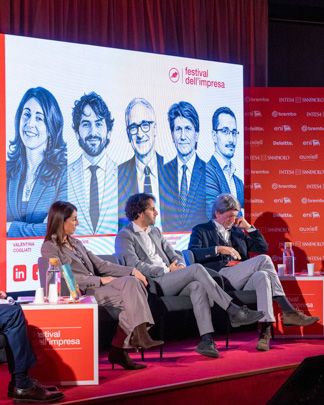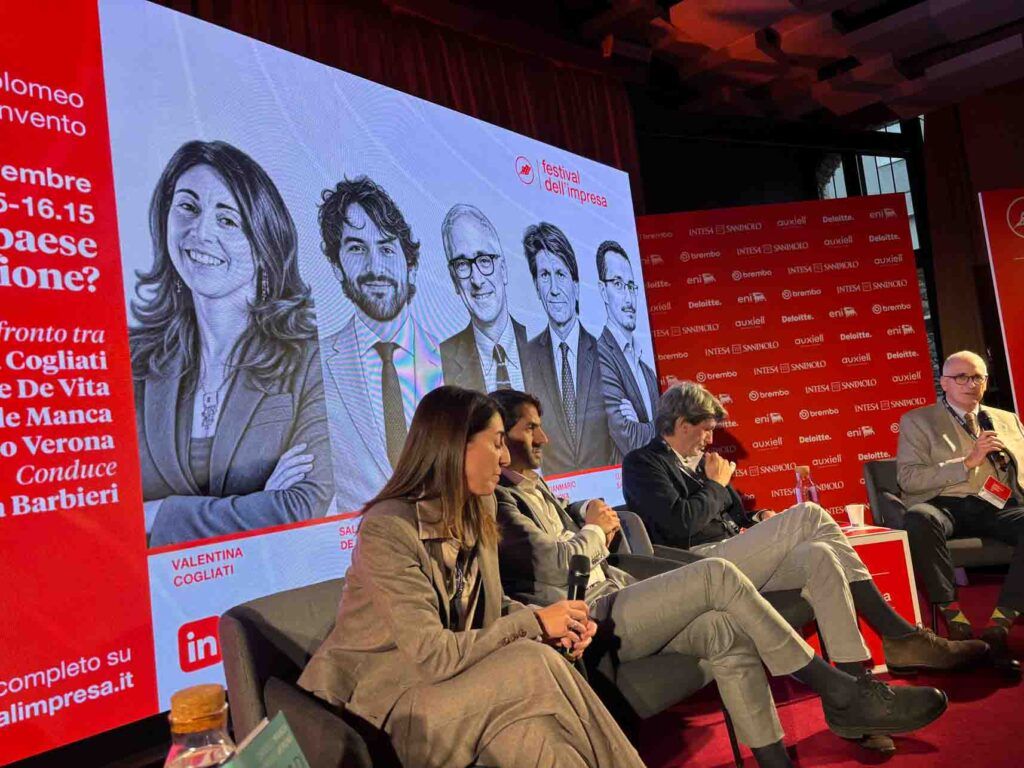
At Festival dell’Impresa in Bergamo, Valentina Cogliati, President and CEO of Elemaster Group, joined a discussion on Italy’s capacity for innovation and on the need to connect industry, research and entrepreneurship more effectively.
Italy can count on globally competitive manufacturers, outstanding research institutions and a deeply rooted entrepreneurial tradition. Yet these individual strengths have not always developed into an innovation ecosystem capable of expressing the country’s full potential. How can Italy make better use of the capabilities it already possesses? And what conditions are needed to transform those capabilities into stronger and more consistent innovation?
These were among the central questions addressed during the panel “Is Italy a country of innovation?”, held on 7 November at Festival dell’Impresa in Bergamo, an event promoted by the Italian daily newspaper ItalyPost. The discussion brought together Valentina Cogliati, President and CEO of Elemaster Group, Daniele Manca, Deputy Editor of Corriere della Sera, Gianmario Verona, Professor at Bocconi University, and Salvatore De Vita, Economic Adviser to the European Commission in Italy. The panel was moderated by Luca Barbieri, Managing Partner at Blum, and accompanied the presentation of A casa di Einstein, written by Manca and Verona.
Technology alone does not create innovation
Verona opened the discussion by focusing on the potential of artificial intelligence and other emerging technologies to accelerate scientific progress and transform entire industries. However, the availability of advanced technologies does not automatically translate into economic development.
Manca brought attention to another dimension of the challenge: the cultural and organisational factors that can limit innovation. Drawing on the themes explored in the book, he argued that the Italian system does not necessarily lack talent or entrepreneurial capabilities, but rather a stronger awareness of innovation as a structured process.
“Innovation is a method,” Manca observed, underlining the need for companies and institutions to understand their capabilities, identify their weaknesses and establish clear priorities.
Cogliati then highlighted an apparent contradiction within Italy’s economic and industrial position. While the country benefits from a strong manufacturing base and significant export performance, the European Innovation Scoreboard 2026 places Italy 13th among EU Member States, at 96.2% of the European average, classifying the country as a Moderate Innovator.
The indicators point to weaknesses in areas including R&D investment, digital skills and the adoption of artificial intelligence. At the same time, according to Cogliati, these measurements do not fully represent the innovation capabilities already present within Italy’s industrial fabric or the contribution made by its research system.
“Our greatest strengths are the excellence of our university and research system and the quality of our industrial base. We need to build an innovation ecosystem around these assets, so that innovation is no longer an occasional initiative by individual companies, but becomes a structural feature of our country,” she said.
As a concrete example of this potential, Cogliati referred to Elemaster’s involvement in the SKAO radio telescope project, where collaboration with the Italian National Institute for Astrophysics – INAF has brought together advanced scientific research and Italian manufacturing expertise.
From existing potential to sustainable growth
The conversation then moved towards the economic and institutional framework required to support innovation over time. De Vita focused on public investment and, in particular, on the approximately €12 billion allocated through Italy’s National Recovery and Resilience Plan – PNRR to measures aimed at strengthening the relationship between research and business.
He stressed the importance of combining investment with reforms, improving coordination between institutions and creating greater stability in research funding.
“What the PNRR has tried to do is provide a shock and demonstrate that, alongside investment, reforms are needed,” he explained, referring to the importance of strengthening links between research organisations, businesses and local territories.
Verona then turned to the role of entrepreneurship and access to capital. Scientific excellence, he argued, must be accompanied by the ability to create businesses, finance innovation and compete beyond national boundaries.
“We need to collaborate, be open and concentrate our efforts,” he said, pointing out that competition increasingly needs to be considered at European level.
Manca added another element: investment and financial resources need to be supported by a common industrial direction.
“Italy does not need more resources. It needs direction, a narrative and an understanding of where it is going,” he said, calling for greater responsibility among political and economic decision-makers.
Cogliati then brought the discussion back to the reality of the Italian industrial system. Given the fragmented nature of the country’s business landscape, increasing company size cannot represent the only solution, particularly in the short term. A more immediate path lies in the creation of networks capable of bringing complementary expertise together.
This becomes particularly important for startups during the industrialisation phase, when an initial proof of concept needs to evolve into a product that is reliable and ready for the market.
“We have to build networks, and we have to do it intelligently,” Cogliati stressed.
This same principle is reflected in Elemaster’s Elevo Innovation Hub, which brings industrial partners, universities and research institutions together to support startups and SMEs in bringing electronic innovations to market.
Innovation as a collective responsibility
As the panel moved towards possible responses to these challenges, the speakers once again emphasised the need for a more coordinated innovation ecosystem. De Vita pointed to long-term industrial policy, stronger technology transfer and public procurement as instruments capable of creating opportunities for innovative companies.
Cogliati identified two additional priorities: greater investment in education and skills, in order to respond to talent shortages, and more consistent incentives for companies that invest in innovation.
The final part of the discussion widened the perspective, focusing not only on how innovation should be developed, but also on what purpose it should ultimately serve.
“The purpose of innovation must be to improve people’s wellbeing. If innovation leads to a deterioration in our quality of life, we have probably pursued the wrong kind of innovation,” Cogliati said, referring to the contribution research can make to the development of technologies and industrial processes with a lower environmental impact.
The debate ultimately brought attention to a challenge shared by both Italy and Europe: making more effective use of their existing scientific, entrepreneurial and industrial capabilities by connecting them through a stronger and more forward-looking ecosystem.
For Elemaster, bringing different areas of expertise together and supporting the industrial development of new technologies already forms part of this approach. The discussion at Festival dell’Impresa reinforced a central idea: innovation is not only about creating new ideas, but also about building the conditions that allow those ideas to generate lasting economic and social value.