In radio astronomy, seeing the universe is not a matter of optics. It is a matter of time.
For the SKA Observatory’s telescopes, observing the sky means aligning signals collected by thousands of antennas, spread across tens of kilometres, and turning them into a single, coherent scientific instrument. This challenge does not begin with images or data analysis. It begins much earlier, at the level of timing, synchronisation and signal integrity. In the SKAO, the margin for error is measured in picoseconds, and achieving this level of precision is one of the most extreme engineering challenges ever faced by a distributed scientific infrastructure.
Why timing matters in a telescope that spans continents
At the most fundamental level, SKAO operates by collecting extremely weak radio signals emitted by distant cosmic sources. These signals reach different antennas at slightly different times, depending on their position in space. To reconstruct a meaningful observation, the system must ensure that all signals are aligned in time with extraordinary precision. Even minimal phase errors can compromise the coherence of the data and distort the resulting scientific output.
In practical terms, this means that signals sampled at 800 million times per second (800 MHz) must remain synchronised across the SKA-Low telescope whose arms extend for up to 74 kilometres. SKA-Low is under construction at Inyarrimanha Ilgari Bundara, the CSIRO Murchison Radio-astronomy Observatory, on Wajarri Yamaji Country in Western Australia. The 40-picosecond figure represents the portion of the timing budget allocated to the Signal Processing Subsystem: each SPS, when compared with an ideal waveform, must not introduce an error greater than 40 picoseconds. At this level, time is no longer an abstract parameter. It becomes a physical design constraint that shapes hardware architecture, firmware logic, system integration and operational procedures.
Digitalisation at 800 MHz: when speed meets structure
The process begins at the antenna level, where analogue radio signals are converted and transported via optical fibres to the processing infrastructure. Once inside the Signal Processing Subsystem, these signals are transformed back into electrical form and digitised. Digitising at 800 MHz means generating hundreds of millions of samples per second for each of the 262,144 channels. The resulting data volumes are enormous and cannot simply be transferred downstream without preprocessing.
This is where the Tile Processing Modules (TPM) play a crucial role. Each TPM aggregates signals from multiple antennas and performs a first layer of processing that makes large-scale synchronisation possible:
- signal aggregation from multiple antennas
- initial synchronisation to compensate for fibre length and antenna positioning
- frequency channelisation
- beam forming for directional observation
At every step, timing accuracy must be preserved. Any drift, jitter or phase misalignment propagates through the processing chain and undermines the scientific validity of the observation.
Engineering precision across a distributed system
From an engineering perspective, the true complexity of SKA-Low lies not in any single component, but in the coordination of thousands of elements operating as one. The Signal Processing Subsystem for SKA-Low developed by Elemaster, through Eletech, the lead company of the International Design Centres (IDCs), R&D division of Elemaster Group, sits at the fourth level of a hierarchical requirement structure. Scientific objectives are translated into system-level constraints, which are then further refined into hardware, firmware and software specifications.
Meeting a sub-40 picosecond synchronisation requirement at this level requires a holistic approach, where timing performance is influenced by multiple, interdependent factors:
- clock distribution architecture
- thermal stability
- power integrity
- electromagnetic compatibility
- mechanical robustness
As a result, timing is not treated as an isolated feature. It becomes an emergent property of the entire system, shaped by design choices made long before the first signal is sampled.
From laboratories to the field: validating time under real conditions
Designing for extreme precision is one challenge. Proving that it holds under real operating conditions is another. To address this, validation activities are carried out across multiple environments, each serving a specific purpose in the verification chain:
- laboratory setups replicating remote stations
- parallel test benches with international partners
- on-site verification under real environmental conditions
Field deployment adds further complexity. Signals travel over kilometres of optical fibre, cabinets operate in remote locations, and environmental factors such as temperature variation and power distribution must be accounted for. Ensuring that timing performance remains within specification requires continuous feedback between design teams, site engineers and scientific advisors. This iterative validation process reflects the reality of engineering at the edge of feasibility: precision is achieved not once but continuously reaffirmed.
Engineering without borders: synchronisation as a shared challenge
The SKAO’s timing architecture is not developed in isolation. It is the result of collaboration between multiple specialised teams distributed across the globe. Each group contributes distinct expertise, spanning scientific modelling, FPGA development, system integration and field operations. Synchronisation, by its very nature, becomes a shared engineering responsibility. No single team can address the challenge independently; it requires coordinated effort, aligned methodologies and continuous technical dialogue across an international ecosystem.
This collaborative dynamic often extends beyond formal technical discussions. During one of the project’s multicultural gatherings, an engineer originally from the United States, now naturalised Australian, famously explained a key aspect of the telescope’s synchronisation logic using a handful of beer coasters during a barbecue. With simple gestures and everyday objects, he illustrated how signals must align in time despite originating from different locations. The episode captures something essential about SKAO.
Extreme engineering does not eliminate the need for human understanding. It depends on it.
Efficiency as a prerequisite for precision
Maintaining timing accuracy at this scale has implications beyond performance. It directly affects energy consumption and system sustainability. High-speed digital systems generate significant heat, and temperature variations can influence clock stability and signal integrity. In SKAO, power consumption and thermal management are tightly linked to timing performance.
Optimising the operating point of digital infrastructure means reducing unnecessary energy use while preserving precision. Even small efficiency gains, multiplied across hundreds of cabinets and thousands of processing elements, translate into meaningful reductions in fuel consumption, cooling requirements and logistical overhead. In this context, engineering efficiency becomes a form of sustainability. Designing systems that are stable, predictable and resilient reduces the need for intervention, maintenance and transport, lowering the overall environmental footprint of the infrastructure.
Synchronising more than signals
At first glance, the challenge of synchronising SKA-Low may appear purely technical. In reality, it extends far beyond electronics and algorithms. Synchronisation means aligning scientific ambition with industrial capability, laboratory validation with field reality, and individual expertise with collective knowledge. It requires precision not only in time, but in collaboration.
By addressing one of the most demanding timing challenges ever posed by a scientific project, Elemaster and Eletech operate at the frontier where hard engineering enables discovery. Here, 40 picoseconds are not just a specification. They are the threshold that allows humanity to observe the universe as a single, coherent system. And in this endeavour, synchronising the universe begins with synchronising people, ideas and technology.
Description:
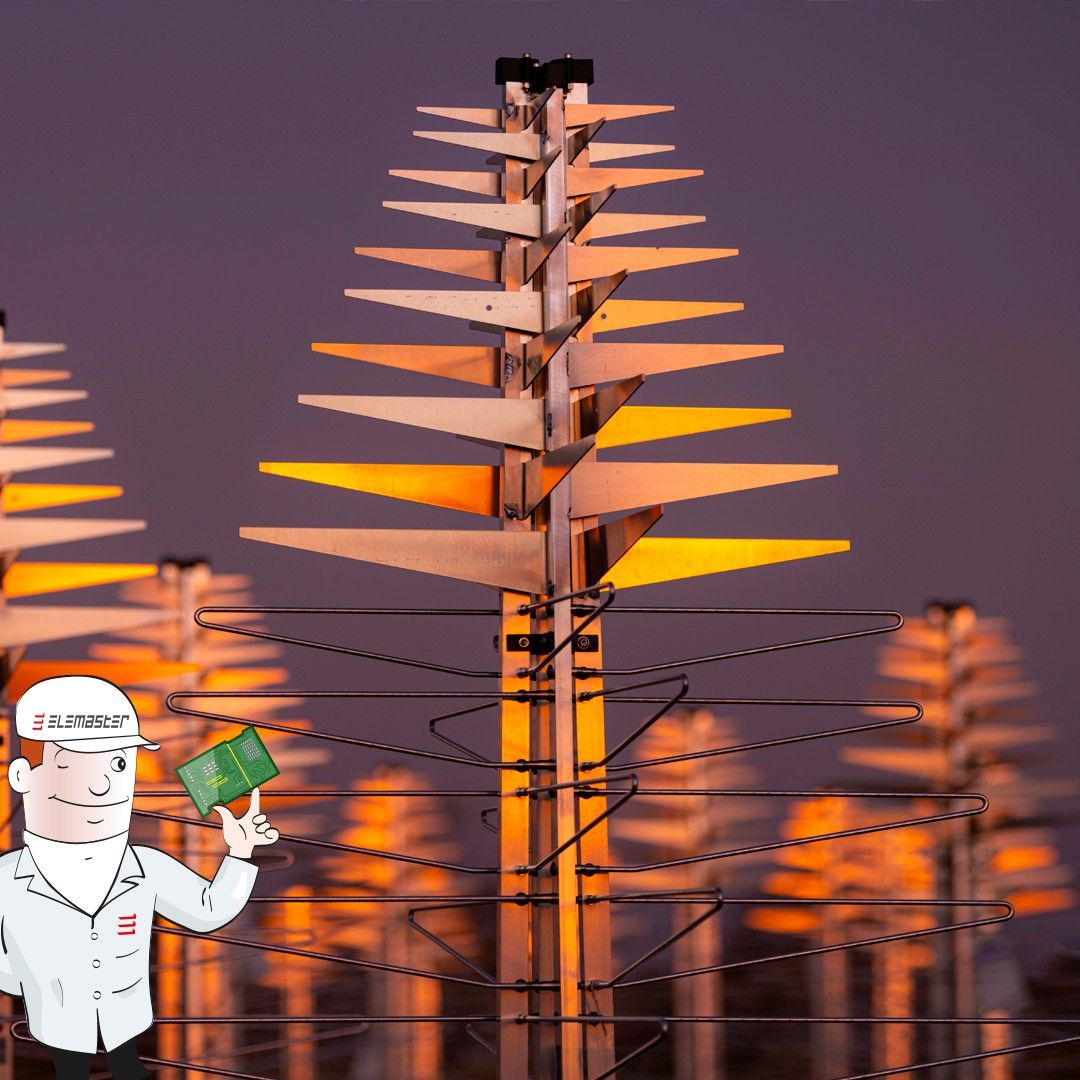
SKA-Low antennas at the S8 station on the southern spiral arm of the SKA-Low telescope.
Credit:
SKAO/Max Alexander