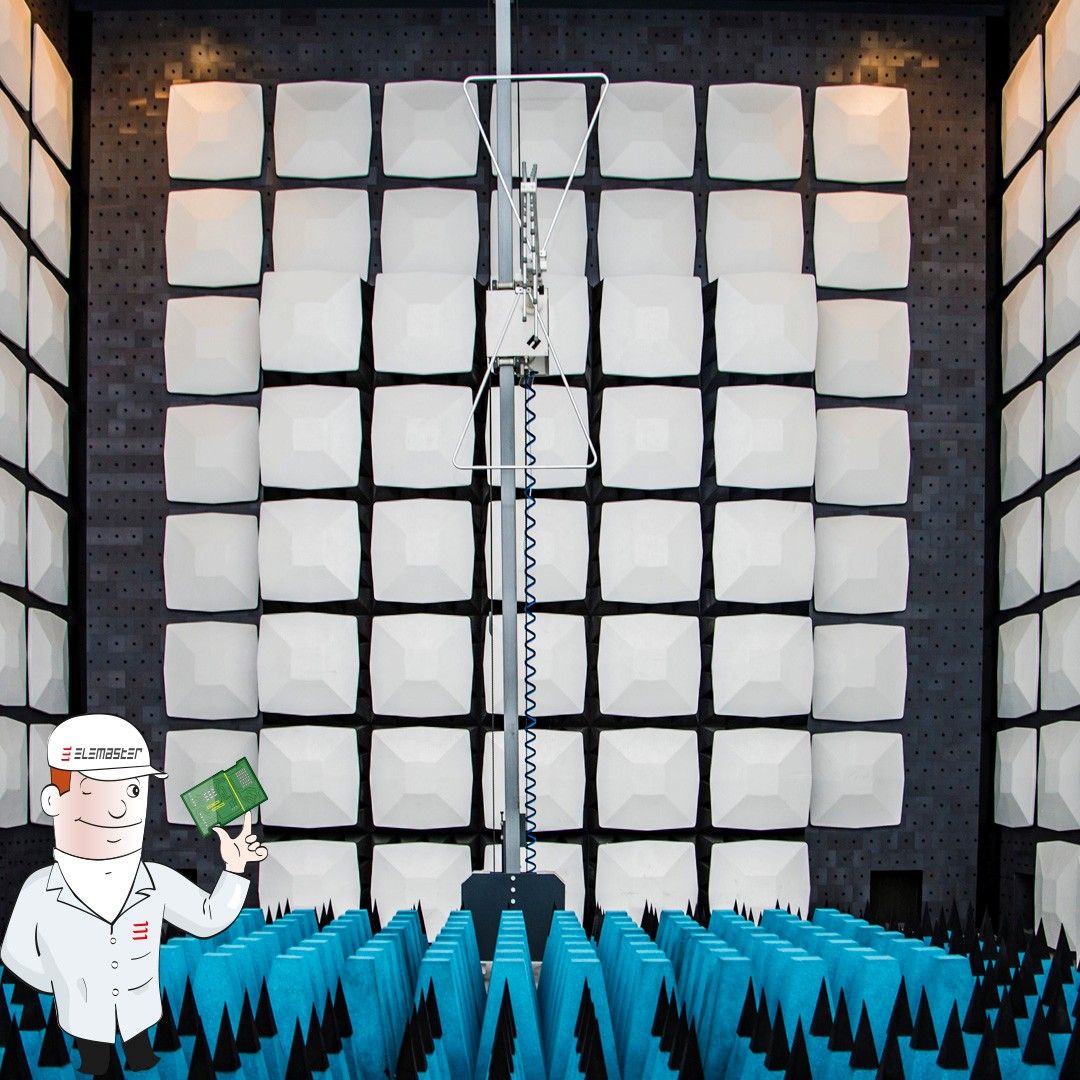
In the world of modern electronics, talking about reliability, regulatory compliance and time-to-market no longer means addressing three separate topics. Today, these elements coexist, influence one another and, when properly orchestrated, become a powerful driver of innovation. It is within this balance that EMC testing has progressively changed its role, evolving from a final verification step into a strategic development tool.
The growing complexity of electronic systems – increasingly integrated, software-driven and rich in interfaces – has made a simple truth evident: the best products are not created when a test is merely “passed”, but when the behaviour of the product in the real world is fully understood. And it is precisely here that the anechoic chamber takes on a new and decisive meaning.
An environment that makes visible what normally remains hidden
The anechoic chamber is not just a highly technological space; it is an environment that brings clarity. By simulating an open field and isolating the device from any external interference, it allows the electromagnetic behaviour of the product to be observed under controlled and repeatable conditions. It acts as a kind of magnifying glass for electronics.
From a physical standpoint, everything is designed to eliminate “background noise”: shielded surfaces, absorbing materials and geometries engineered to cancel reflections. But the real value does not lie in the structure itself, rather in what it enables: transforming an invisible phenomenon into usable information.
It is in this context that dynamics emerge which are difficult to detect elsewhere. Unexpected couplings, effects related to cabling, and interactions between PCB layout, enclosure and shielding suddenly become readable. Not as abstract issues, but as measurable and, above all, explainable behaviours.
From data to understanding: when testing becomes a dialogue with the design
One of the most compelling aspects of the advanced use of the anechoic chamber is the possibility of working iteratively. Measure, intervene, observe again. Every change produces an immediate response.
This approach transforms testing into a genuine dialogue with the design. It is no longer about waiting for a final verdict, but about accompanying development step by step, understanding the cause-and-effect relationships that govern the EMC behaviour of the system.
In this process, the value lies not only in detecting that a limit has been exceeded, but in understanding why it happens. It is a subtle yet decisive difference: identifying a disturbance is a starting point; understanding its origin is what enables better design.
Pre-compliance: the moment when the project learns from itself
This is where pre-compliance expresses its full potential. Bringing the anechoic chamber into the prototyping phases means offering the project an opportunity to learn while it is still flexible. At this stage, every piece of information has multiplied value.
Intervening on cabling, filters, shielding or layout while the product is still evolving allows performance, timelines and costs to be optimised. Not as a reaction to a problem, but as a progressive refinement of the solution.
In many cases, a clear hierarchy of interventions emerges: cabling and enclosures often represent fast and effective levers; the PCB, more complex to modify, becomes the final step of a process that is already informed and conscious. This approach drastically reduces uncertainty and makes the path towards certification far more linear.
The value of expertise: technology and people working together
An anechoic chamber, no matter how advanced, expresses its true potential only through the people who use it. The skills of technicians, deep knowledge of EMC standards and the ability to interpret their principles make the difference between a correct measurement and a truly useful one.
Procedures are defined by standards, but their application requires experience and method. Every product is different; every architecture has its own specificities. For this reason, preliminary analysis of interfaces, ports, cable lengths and real operating conditions is a fundamental step.
When laboratory and design teams work together, the test plan becomes a shared tool, built on two levels: theoretical analysis of documentation and practical verification on the prototype. It is a process that strengthens data quality and confidence in the decisions derived from it.
Software and EMC: an increasingly evident alliance
Another element that clearly emerges today is the role of software in EMC performance. In complex systems, software maturity can significantly influence test results. Anomalous behaviour, instability or false alarms may depend on software logic that is still evolving.
In many cases, a new release is sufficient to dramatically improve system response, without any hardware intervention. This link between software and EMC highlights how modern testing is increasingly focused on overall system robustness, rather than on a single domain.
The value of an integrated ecosystem
At this point, the Group dimension becomes a natural accelerator. As highlighted by the corporate vision, the integration of the Eletech Laboratory within Eletech, the lead company of the International Design Centres (IDCs), R&D division of Elemaster Group, makes it possible to place EMC testing at the centre of the supply chain, not at its margins.
When design, industrialisation, production and validation communicate without barriers, testing ceases to be a bottleneck and becomes a lever for speed. Decisions arrive earlier, processes are smoother and time-to-market is structurally reduced.
This approach changes not only the way testing is performed, but the way products are designed. The laboratory is no longer a downstream service, but an enabling function that contributes to the overall quality of the product.
A new culture of testing
Talking today about the anechoic chamber means talking about a cultural transformation. It means describing electronics that evolve, design processes nourished by reliable data, and testing activities that do not limit innovation but make it more robust.
The real leap forward is not the ability to measure better, but the ability to understand earlier. Before the project is frozen, before costs escalate, before the market is forced to wait.
In this sense, the anechoic chamber is not just a test environment: it is a space in which engineering becomes aware of itself. And it is precisely from this awareness that the most robust, reliable and real-world-ready products are born.